
Introduction
This article plans to examine and propose an efficient approach to strength-and-Conditioning for the boxing athlete to improve right cross (RC) punch efficacy. The RC is a full body movement with combined force coming from the ground through leg drive creating a kinetic chain and power generation transferred to the trunk and then the upper torso. (1)
Defining the Movement:
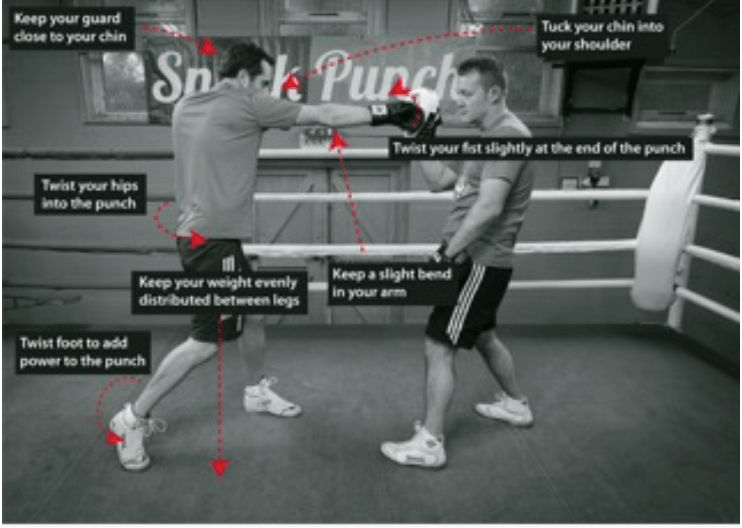
Starting from a relatively square hip-stance with slight angulation of the left hip forward. Both arms start at the head, elbows in. The punch comes from the posterior right hand driving the shoulder into slight protraction. Elbow is kept flexed and attached to the body until it crosses the hip line, before it is extended to complete the punch. (2)
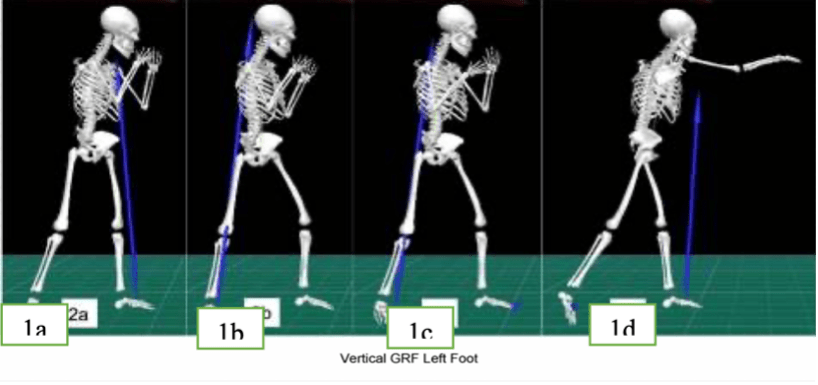
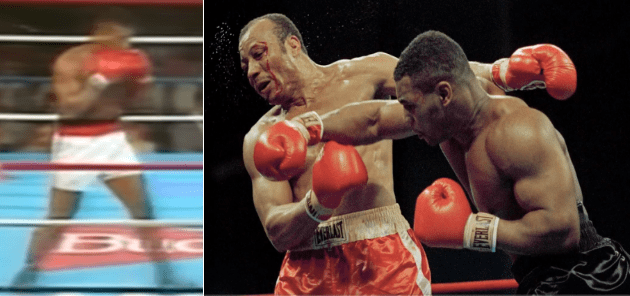
Rotational torque, and power, is generated through the connection to the floor. The right hip dips in the coronal plane, moves anteriorly in the sagittal plane and rotates internally. The left hip moves slightly downwards and backwards within the sagittal plane (Figure 1 and 3). (3-5)
The Right-cross (RC) is accommodated through 3 primary contributors: the arm, trunk and drive of the legs from the ground (6).
Movement dynamics
The fundamental principle in boxing hinges on the notion that one maintains balance, whilst moving in such a way that one’s opponent is off balance. (7)
No single muscle is responsible for punching power in the right cross; It is a movement combination. The contribution of each muscle is presented in table-1. (8)
Table 1: Individual muscle groups – Eccentric, Isometric & Concentric function
| Muscles (Concentric – Isometric – Eccentric) | |
| Upper Torso | – Pectoralis Major (adduction, internal rotation, flexion of humerus and shoulder joint . Involved in stabilizing the functional movement chain.) – Latissimus Dorsi (Often overlooked muscle, but of importance in keeping the punch tight, and allowing for transferal in biomechanic chain from the ground. Adduction, Extension and Internal rotation of arm. Aids in respiration, breath out on punch). – Teres Major (Assists the latissimus dorsi in adducting the humerus downwards and backwards – Important in stabilizing humeral head, and keeping tight kinetic chain, for transferal of power from legs.) – Trapezius – Brachii Lateral head; Triceps Brachii Long Head; Triceps Brachii Medius (Triceps muscles involved in the last initiation phase of action. Move alongside kinetic energy already created by the full body kinetic chain – guided by high velocity of body kinematics and other contributors- arm punchers with over recruitment of this muscle is inefficient) – Rotator Cuff (Subscapularis; Supraspinatus; Infraspinatus; Teres Minor). – These muscles form an important structure in stabilizing the shoulder. They perform some important functions including rotating the upper humorous internally as well as external rotation in getting back to the neutral position.- Anterior Deltoid – Is the main muscle that can work to increase power, working with the pectoralis major to concentrically create power generation and pull the shoulder into an efficient position for impact at end point of punch.- Bicep (Short and Long head of Branchii) – Although the biceps are involved concentrically in pulling the punch back and eccentric loading on hit, they are not the major power generator of the punch. But they help to facilitate the muscle sling involved in a punch. |
| Trunk | – Internal & External Abdominal Oblique (Ipsilateral rotation and lateral flexion of the trunk – Rotation of trunk to opposite side depressing thoracic cavity)- Serratus Anterior (Boxers Muscle – Draws scapula internally and forwards, aiding in protraction of shoulder, keeping punch tight as well as additional torque)- Transverse Abdominus (Involved Isometrically in stabilizing and keeping the kinetic chain and power transfer intact as it comes from the ground)- Rectus Abdominus (compression of abdomen, trunk flexion with stabilization – aiding in RC power transfer). |
| Lower Torso | – Gastrocnemius (Initiates power and movement, boxer on toes, facilitates drive – contralateral front gastric eccentrically absorbs load and maintains balance.)- Gluteus Maximus (Rear: Prime mover in hip extension, used in proximal range, then other antagonist muscles take over)- Gluteus Medius (Slight abduction of hip, and stabilization of the pelvis, anterior fibers engage for internal rotation and flexion.)- Rectus Femoris (Flexion of Hip joint – recruited in proximal range on contraction in back leg- Lead leg then works eccentrically to maintain balance after punch thrown).- Biceps Femoris Right back leg (involved in added power by flexing knee and taking over from rectus Femoris as it is an antagonist muscle). Front leg, eccentrically loads at end range of punch.- Adductor Longus (Adduction and flexion of hip. Extension + Internal Rotation of femur. Pelvis Stabilization. Concentric activation, followed by eccentric stabilization at end of motion in back leg). |
Muscle recruitment:
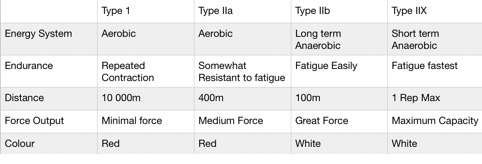
Boxing has a 70-80% dependence on anaerobic processes, 20-30% aerobic(15). Boxing RC activates type IIb/IIx myosin fibers which enable high speed contraction for maximum force. (16)
Muscle fibers include a combination slow fatigue resistant (Type-1) and fast twitch, high hypertrophy, explosive Power (Type 2) fibers. (17)
Fiber types can be seen in Fig-3 Below:
Table-2 Muscle Types:
The sliding-filament theory explains how muscle fibers are stimulated. An actin filament glides over the myosin filament. The length of filaments does not change when the muscle is contracted, however the length of the sarcomere is decreased as the actin moves and glides past the myosin filaments. The z-discs in turn are pulled towards the center of the sarcomere. (20) This is shown in figure 3 below:
Figure-3 Graphical Illustration of pre/post contraction of muscle fiber.
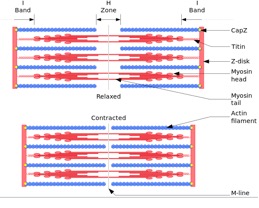
From Relaxed state, to Maximal Power Generation and back
Delvechio suggests that the traditional high aerobic mindset in traditional boxing trainers, must be replaced with stronger influence in anaerobic strength and conditioning rather than aerobic protocols. (23)
Type-1 fibers also play a fundamental role. The boxer needs to maintain his balance, in constant motion. (24) Type-1 fibers activated and relied upon with regards to keeping good posture and a solid balanced stance at all times. (13)Bruzas et al. point out that aerobic fitness in boxers is directly correlated with the rankings of professional boxers. (25) It should be concluded that in the RC movement, good aerobic fitness and stability control is of vital importance in maintaining the balance required, to best be able to execute the RC with fluidity and from an energy conserving state, to generate explosive power of the RC at an opportune time. (26)
As the explosive power of the punch mechanism, shouldn’t leave the boxer out of postural position at any time the boxer can’t rely only on anaerobic contractions of type-II muscle fibers and constant high output contraction through the entirety of several 3-minute rounds (2).
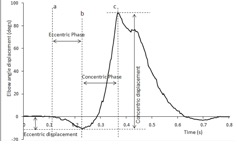
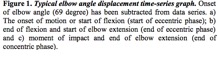
The natural stretch shortening cycle (SSC) is important and is engaged in a functional combined movement such as the straight-RC. (6) The dynamic involves an eccentric stretch of the agonist muscle followed by a rapid shortening in the concentric phase, creating more power in the punch. (1) This is known as pre-stretch. It has a reflex component that acts like an elastic band. When stretched it snaps back. This is a counter movement component, which increases the ability to utilize a stronger velocity/power mechanism. It is further observed that eccentric strengthening improves performance in the SSC (27). This is also seen in the elbow. As shown in Figure 4, we see a pre-eccentric stretch reflex before the rapid concentric firing stage in the elbow.
Figure-4 Pre-Stretch Eccentric loading before Concentric max power: Elbow Displacement.
(1)
(3)
Muscles involved breaking down the kinetic chain:
With regards to the upper torso, one of the mechanisms of power generating concentric extension of the humorous would be the pectoralis major and anterior deltoid. (Fig.6)
Figure 6 – Function of pectoralis Major and Anterior Deltoid ) Incline-press.

(28)
Lopez (11) explores the relationship between bench press(BP) and punch RC performance. Although Correlation is found between 1RM max performance in BP and punching power, the effect and direct influence is speculative due to low specificity of the complete movement and technique of the athlete. The right cross is an asymmetrical motion and the bench press is not. Irrespective however, stronger punchers of the RC had better BP outcomes. Power generated from a relatively isolated muscle as exhibited in the BP can be correlated to power and punch efficacy of the RC. Overload of the muscle even in non-sport specific exercise creates applicable RC power. (29)
Filimonov et al. analyzed 120 boxers, showing that as experience and competitive level of the boxer increased, so did the amount of force contribution from the lower trunk. (30) Giovani and
Nicholas show that amateur boxers, with higher maximal power in the legs, derived higher maximal force in the upper limbs. (10)
It is however important to note that the end point of contact is the upper limb. And for the power of the legs to effectively be transferred to the upper limb, balance technique and stability become primary drivers of delivery as shown in Figure 5 & 7.
Fig-7 – Key Drivers of Punching Power
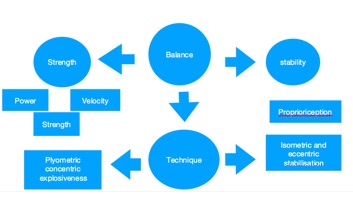
A performance exercise program must focus on strengthening the significant systems that best allow the athlete to benefit from mechanically correct movement.
Guidetti (31) also points out that grip strength is also correlated with increased total power efficiency in the RC as it allows for Isometric contraction and stabilization in transferring energy from ground to upper extremity, highlighting the importance on full system stability, and training with an emphasis on power generation.
The Force Velocity curve is show in figure-8. The inverse relationship between force and velocity shows us that when force output is maximized slower movement is produced. To increase power, we need to consider both Velocity and force and the prescribed exercise needs to compromise of both movement and load. (12) Trade-off between force and velocity is believed to happen because there is a decrease in time for cross bridges to be able to form in high velocity exercise. More cross-bridges are associated with a greater contractile force. Slower velocity/high force exercise allows more time for these cross-bridges to be formed, (32) however has the opportunity cost of reduced muscle contractile velocity. (33)
Figure-8 Force Velocity Curve

(7)(28)
Yoon et al. (14) show that isometric trunk-strength is associated with anaerobic power and maximal strength.
Professional boxers emphasize power generation and hit harder often from a closer distance, whereas Amateur boxers, tend to hit more punches at end range, with more focus on velocity and speed, rather than power generation. This can be attributed to scoring and rule differences and the fact that knockouts are less commonplace in amateur boxing with a greater emphasis on points. (12) This highlights the importance of the length-tension relationship in generating force in the RC. The length-tension relationship dictates that isometric tension in the muscles is indicative of the amount of cross-over of actin and myosin filaments (Figure-9). This shows, us that pure force generation does not come at end range of the punch, but at mid-range. (34)
Figure-9 Length-Tension relationship of Sacromeres presented in graphical form
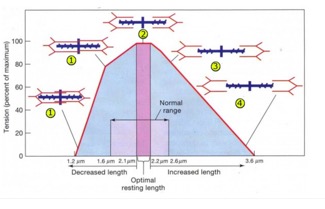
(35)
Exercise Prescription
Each athlete, should be assessed in a comprehensive SWOT (Strength; Weaknesses; Opportunities; Threats) (36)analysis (37). Case-Study A (Appendix) wants to focus on Power Generation of an already conditioned athlete. This is a middle-weight boxer, and we do not want to hypertrophy. We will use the overload principle and 80% of 1RM 4-6 sets for power gains with increase in resistance every week for the first 6 weeks. (38) Our periodization will focus on Macrocycles (38), based on the length from the event and the coaches periodization cycle based roughly around USOEC Guidelines (39). Our strength and conditioning program to improve RC power is designed to fit into the athlete and coaches boxing training regimen.
The boxer should ideally go through 4 cycles: “preparation, general strength, pre-competition and active rest” (39). Our program has been included in the boxers ‘General strength’ (16 weeks pre-competition) and ‘pre-competition’ phase. (10 Weeks pre-competition). Each phase runs for 6 Weeks. This has been done as boxers should not periodize with a strength/power focus 6 weeks before Competition. The next 6 weeks we have included plyometrics to increase velocity and speed and less emphasis on power. (39) We have then allowed for 4 weeks pre-competition for exclusive focus on boxing specific training with their coach. The active-rest cycle happens after competition. It is intricate that boxers feel confident and have some familiarity and confidence in their training regiment, as the psychological burden of entering a fight cannot be understated. (40)
Conclusion
Developing a generic approach to inherent power in the RC has evaded boxing experts and SC coaches for years. This is likely due to the fact, that it cannot exist in a movement as complex as the RC in boxing with athletes of different genetic traits. The approach must be focused on individualized assessment of the individual athlete and a boxing program prescribed based on a SWOT analysis, and multidisciplinary team.
References 1
5. McNeil WF. The Rise of Mike Tyson, Heavyweight: McFarland; 2014.
10. Giovani D, Nikolaidis PT. Differences in Force-velocity Characteristics
of Upper and Lower Limbs of Non-competitive Male Boxers. Int J Exerc Sci. 2012;5.
15. Delvecchio L. Profiling the physiology of an amateur boxer. J Aust Strength Cond. 2011;19:37-47.
20. Donatelli RA. Sports-Specific Rehabilitation – E-Book: Elsevier Health Sciences; 2006.
21. Cleri F. The Physics of Living Systems: Springer International Publishing; 2016.
23. Delvechio L. Profiling the psychology of an Amatuer Boxer. J Aust Strength Cond. 2011;19:37-47.
24. Vít M, Chudoba O. Innovative methods in boxing training Bachelor’s diploma thesis. 2017.
26. Haislet EL. Boxing: Ronald Press; 1968.
28. Ratamess NA. ACSM’s Foundations of Strength Training and Conditioning. 23 ed. USA: LWW; 2011.
29. Fitness IP. Developing a Strength-Power Program for Amateur Boxing. 1997.
32. Zatsiorsky VM, Kraemer WJ. Science and practice of strength training: Human Kinetics; 2006.
35. Sheffield TUo. Length-Tension Relationship 2020 [
36. Robinson PE. Foundations of sports coaching: Routledge; 2014.
38. Smith N. Periodization of a Boxer. 2011.
40. Riley BG. Boxing and psychology. Physical Educator. 1943;3(3):95.
Appendix:
Case Study A:
27 year old professional middleweight Boxer A seeking a strength and conditioning program to improve efficacy of his right cross in upcoming fight in 16 weeks against Boxer B
Subjective Assessment:
Multidisciplinary meeting with coach and athlete. Utilization of SWOT analysis as recommended in article.
| Stengths | Weaknesses | |
| Boxer A | Superb Aerobic conditioning. Workhorse, Road Warrior. No problems into later rounds. Great Point fighter. Fast and technical. Good core strength. Creates openings to land power shots. Good velocity on punch. Great defensive skills, runner, able to evade well. | Has trouble finishing opponents despite great technical openings and landing shots. Balance stabilisation can improve in overloading power punch. |
| Boxer B | Gets stronger as fight progresses. Relentless forward pressure. Dangerous power through fight. Power Puncher. Many later round knockouts. Willing to trade to get shots in. | Opens guard to trade. Can be slow in movement. |
| Opportunties | Threats | |
| Boxer A | Evasive and movement superiority.Many opportunities to get power shots in whilst evading.Early power shots, may slow down opponents forward pressure. | Facing power puncher. Relentless forward pressure and danger of knockout. |
| Boxer B | Foreward pressure can tire opponent early. Can take punishment but wins trades due to power. | Unable to return punches against runner, with respectable power. |
Goal of strength and Conditioning program based on Gameplan:
Coach and Boxer A have decided, that the strategy for upcoming fight, is to increase power of right cross, whilst maintaining balance, and stability/movement. The game plan, is to keep distance and punish pressure boxer B with a running game, but improve power output utilizing Boxer A’s Running and evasive style, at a safe distance without trading punches. (Right cross is a long range punch).
We have decided to incorporate a 12 week strength and conditioning program based on this goal, that will be incorporated into the boxing training protocol. There will be 4 sessions a week dedicated to this goal, for 12 weeks. First 6 weeks, will be dedicated to power and strength of upper and lower body. The following 6 weeks, will add plyometric exercises. Program will also develop eccentric and Isometric stabilization as increased power in punches will have more demands in eccentric capacity to pull punches back and move. These exercises will be fit into the regular boxing workout protocol with the coach, and will form a part of the strength and conditioning regiment.
This will be followed by a twice a week ‘maintenance’ period of gains in the final 4 weeks leading up to fight day, where Boxing technique, recovery and other aspects of training will take priority.
Warm-Up/Replacement activity to Increase HR
15 minutes rope skipping Depending on Upper body lower body, athlete preference.
Warm-Down
10 Minutes Skipping.
10 Minutes Stretch or Ice Bath.
Notes:
Program has been created, to fit into the athletes Boxing Specific program. The boxing coach will increase heavy bag work, and maximum output pad work.
The purpose of this program is to create the ability to overload the athlete increasing strength and power. Plyometric days are added from week 6-12, to keep velocity speed. We have also focused on several core stabilization exercises.
We want to focus on Power Generation of an already conditioned athlete. This is a middle-weight boxer, and we do not want to hypertrophy. We will use the overload principle and 80% of 1RM 4-6 sets for power gains with increase in resistance every week for the first 6 weeks. (38) Our periodization will focus on Macrocycles based on the length from the event and the coaches periodization cycle based roughly around USOEC Guidelines (39). Our strength and conditioning program to improve RC power is designed to fit into the athlete and coaches boxing training regimen.
The boxer should ideally go through 4 cycles: preparation, general strength, pre-competition and active rest (39). Our program has been included in the boxers ‘General strength’ (16 weeks pre-competition) and ‘pre-competition’ phase. (10 Weeks pre-competition). Each phase runs for 6 Weeks. This has been done as boxers should not periodize with a strength/power focus 6 weeks before Competition. The next 6 weeks we have included plyometrics to increase velocity and speed and less emphasis on power. (39) We have then allowed for 4 weeks pre-competition for exclusive focus on boxing specific training with their coach. The active-rest cycle happens after competition. It is intricate that boxers feel confident and have some familiarity and confidence in their training regiment, as the psychological burden of entering a fight cannot be understated.
Program First 6 Weeks – Phase 1 – Strength/power acquisition Isolated movement:
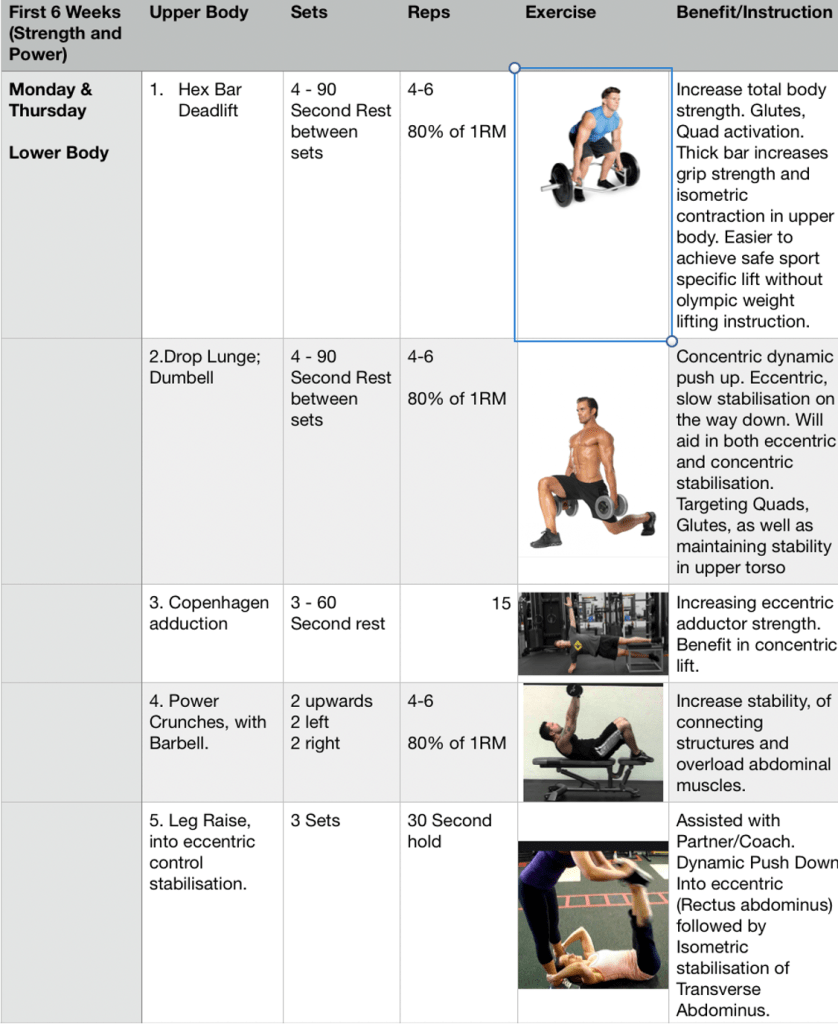
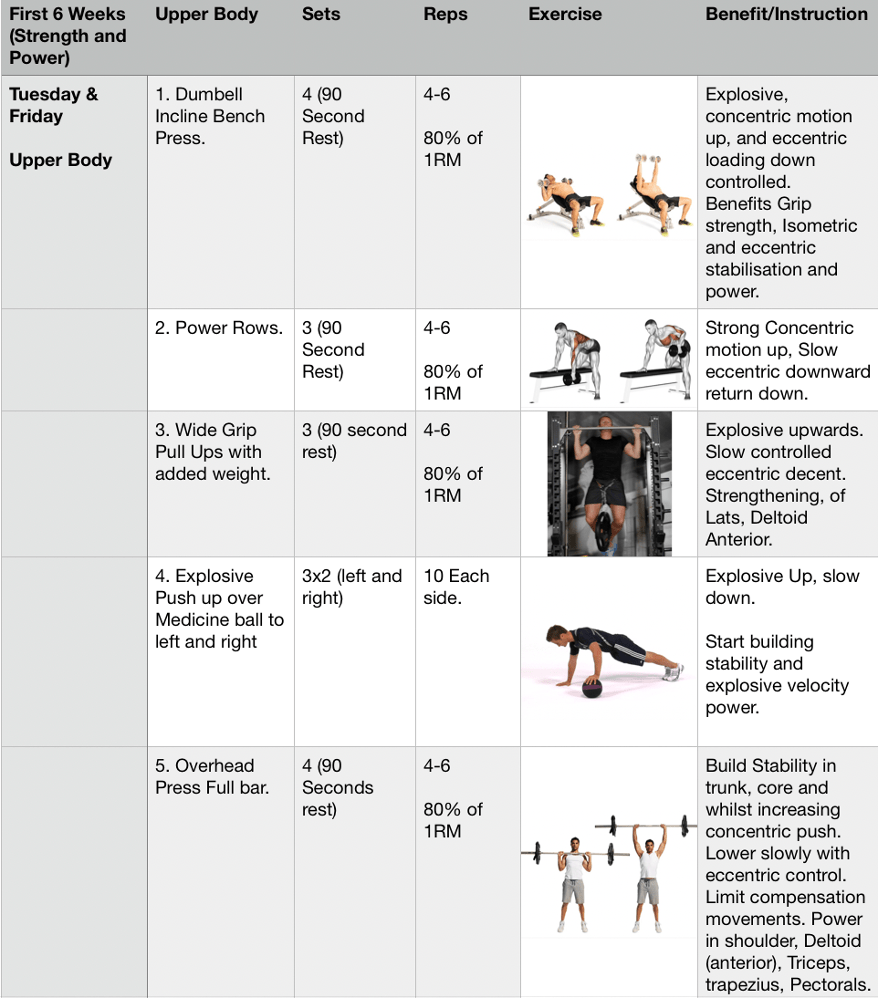
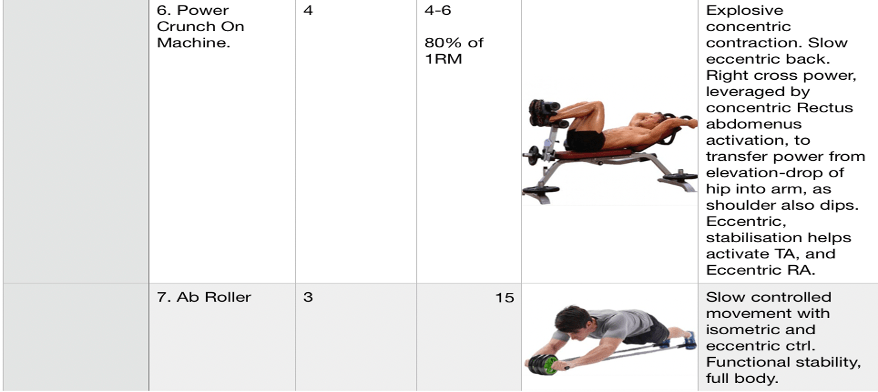
Weeks 6-12: Addition of Plyometrics, Sprints and whole body movements. Monday and Thursday. Adaptation for utilising Power gained from week 1-6 into a more Velocity and functional movement, but maintaining Power on Velocity/Force Curve.

Wk 6-12 Tuesday & Friday: Full Body Gym Work.
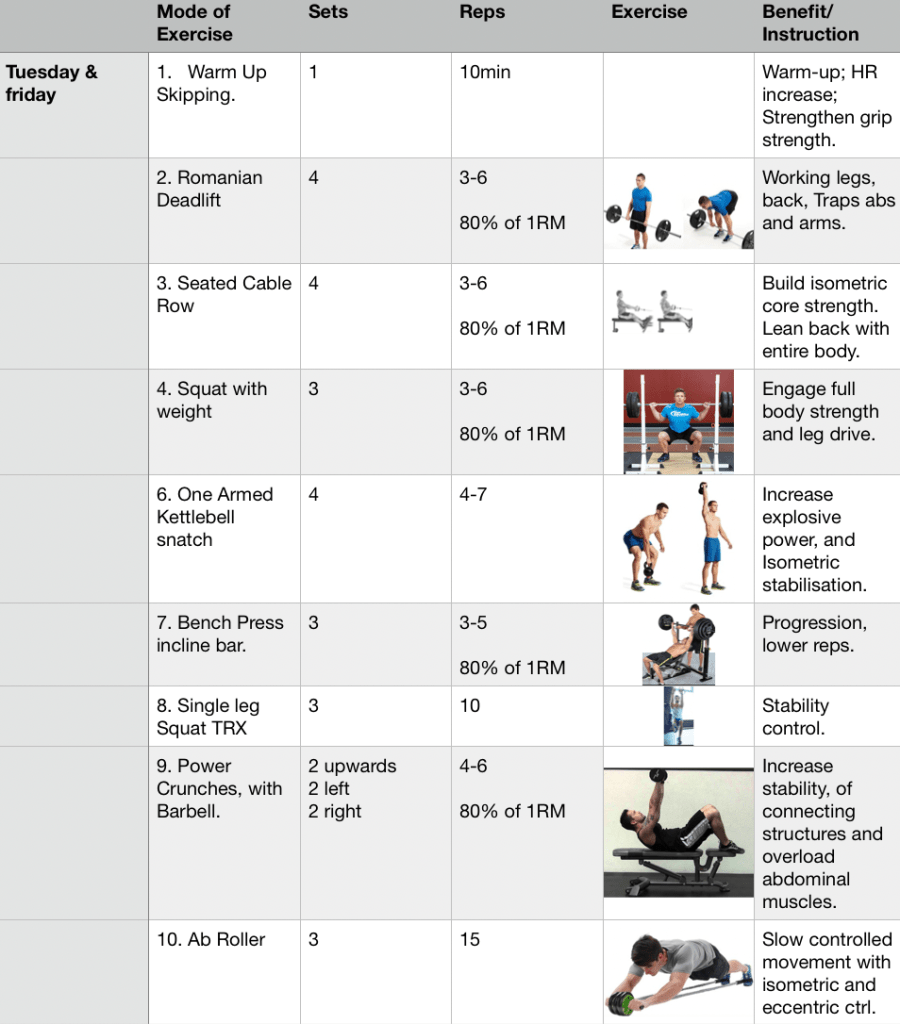
4 Weeks Remaining before fight: Focus on Boxing Specific work only with Boxing Coach. Emphasis on game-plan, and adopting full power pad work and heavy-bag work. Safe zone to adapt and peak workload, or maintain according to how athlete is progressing.
Author:
Constantinos Hadjichristofis – Bcom Human Resource Management (Wits) Personal Trainer (ACSM) BSc (Hons) Physiotherapy (Herts) MSc – Sports Medicine, Exercise and Health (UCL).
 Biokinetic - Physical Rehabilitation Home and business Services - Nicosia Cyprus - HCPC - CSP - GESY